
I’m Trying to Love Persona 5: The Phantom X, But It Just Hasn’t Stolen My Heart

I got into Atlus’ critically acclaimed Persona franchise a few years ago seemingly against my will, and it’s had its hooks in me ever since. I had tried off and on with Atlus’ esteemed RPGs for years; I fell in love with Shin Megami Tensei III: Nocturne on the PS2, but it was just a little too much for me to wrap my head around at the time. I tried like hell to get into Persona 3 FES, even going so far as to stream the first major segments of the game, but it just never clicked with me (until last year’s Persona 3 Reload, that is).
No, like every other recent fan, it was Persona 5 Royal when I finally “got” what made this so special. How I feel about Persona 5 Royal can change on a whim based on the mood I’m in that day and what the last Persona or SMT game I played was, but it is undeniably a powerhouse in the JRPG genre and a brilliant entry point into the franchise thanks to its bombastic tone and perpetual sense of adventure.
Atlus, of course, noticed that success too, which is why we have gotten a seemingly endless barrage of Persona 5 spin-offs since its 2016 PlayStation 3 release. A dancing game, a Dynasty Warriors clone, a tactical strategy game, and even a crossover with Persona 3 and Persona 4 have kept Joker and the Phantom Thieves close to the hearts and minds of fans. And if that wasn’t enough, cameos in Super Smash Bros. Ultimate, Super Monkey Ball: Banana Mania, and the upcoming Sonic Racing: CrossWorlds show just how much versatility Persona 5 has.
But now, Atlus has broken new ground again with its first earnest venture into a mobile Persona, Persona 5: The Phantom X. Atlus has already taken a stab at mobile games with Shin Megami Tensei Liberation Dx2, but that was closer to Pokémon Go, whereas Phantom X is a full-featured mobile JRPG. This is an undeniably ambitious venture, and one I’ll undoubtedly spend more time with, but I think you can see my frustration with the game mounting over the roughly six hours or so that I streamed.
I Am Thou, and So On, and So Forth
Narratively, the game is a bizarre twist on what you know and love. It’s Persona 5, but everything is ever so slightly off, as exemplified by the opening mission, where you recreate Joker’s escape from the original game but with a new protagonist, Wonder, occasionally subbed in through a glitch. Narratively, Wonder is an interesting inversion of Joker, a seemingly doted-upon son who is left to his own devices while his parents travel afar. He’s got more or less a mansion to himself, is at least recognized by his classmates (though, curiously, doesn’t seem actually to have friends), and mostly knows his way around town. The fish-out-of-water aspect of every Persona title is absent here, though Wonder is just awkward enough that he still needs help finding his way or talking to strangers from time to time.
That’s part of what makes it weird. The game does seem to assume you’re familiar with Persona 5 if you’re playing this one, so there are a lot of mechanics thrown at you right away. Most of your battle mechanics are introduced within a few fights, and you can level up characters to relatively huge numbers in the early game, but things like changing out weapons are locked away (even though I got a few powerful ones as a welcome gift) until you progress the plot far enough to unlock the Airsoft Shop. The game spends more time guiding you through the social aspects of gameplay than it does anything else. I’m six hours in, and I haven’t even had the opportunity to hang out with any Confidants, despite unlocking multiple Social Links. However, I have learned to cook, farm, work a day job, and fuse Personas.
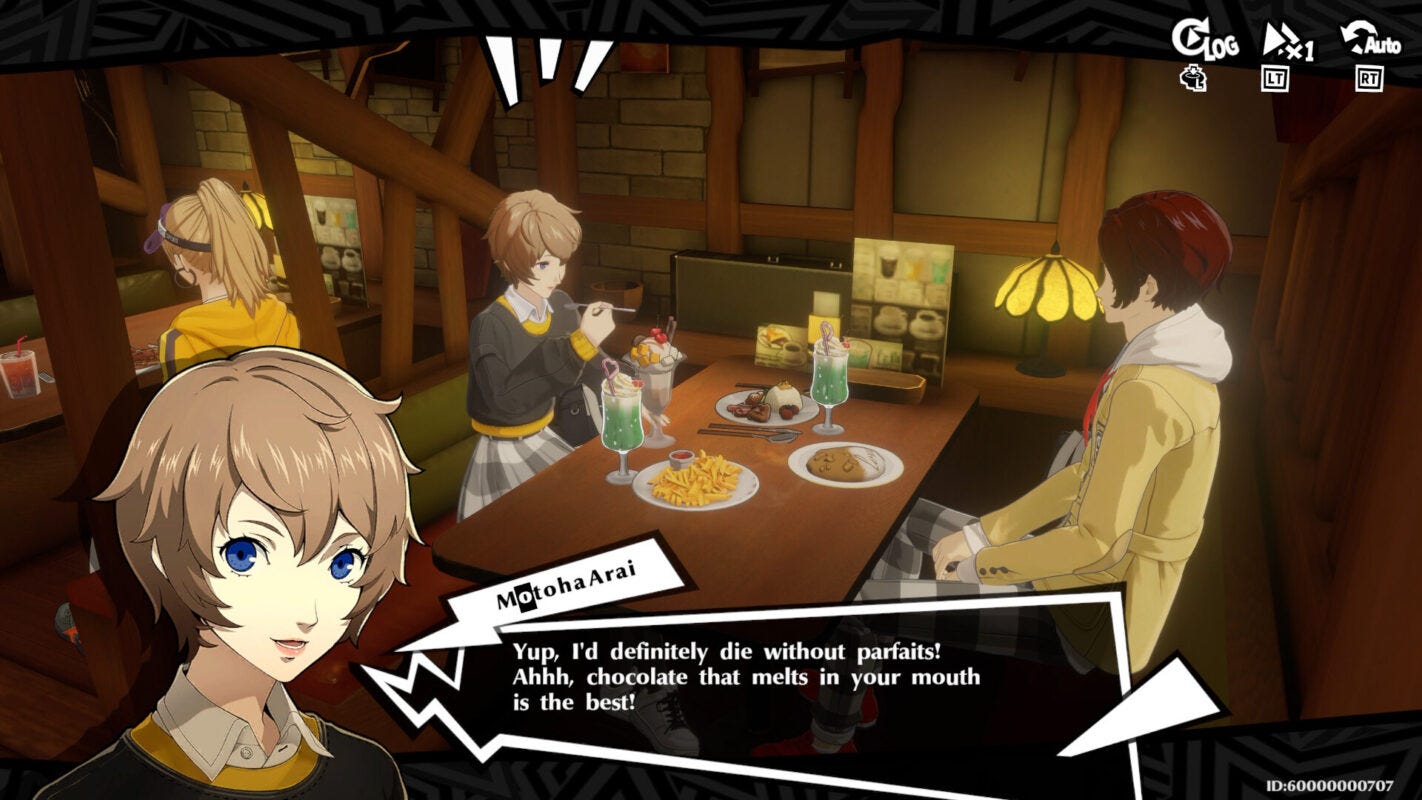
The story then kicks in, and man, I don’t know how to feel about this opener. Remember Persona 5‘s first Palace? Kamoshida, the school’s gym teacher, is abusing your classmates, both physically and sexually. There are some real stakes in this, because you know there will be untold horrors inflicted upon your peers if you don’t stop him. Not only do you want to kick his ass, but you feel invested in it because you like the other characters you’ve met so far. You are actively rooting for Ann to get her revenge.
Compare this to Phantom X‘s first Palace master, Takeyuki Kiuchi. He’s a former up-and-coming baseball player who fell into a slump after one of your party members embarrassed him at a Little League game. Now, years later, he’s aggressively slamming into people, which has earned him the moniker The Subway Slammer. He’s getting away with it because he claims it was an accident, and the police do nothing. You don’t even initially do anything about it. Wonder only gets involved because he has an unexplained vision of a future where Kiuchi knocks over a woman whose baby falls to its death. The efforts to stop Kiuchi are finally kicked into high gear when a classmate (whom you barely know) falls victim to his Slamming, but that’s just for another party member’s sake; Wonder is already in the thick of it by then.
Not only is it a far cry from the serious tone and stakes of Kamoshida, but the setup gives me no real reason to care. Wonder has no personal connection to Kiuchi; you must wait for Arai to join your party to learn about his connection to your Phantom Thieves. Arai is in it because her friend Tomoko was hurt, but we barely know Tomoko at this point. You’re only this far in because your guide, Lufel, is trying to teach you about the Metaverse, and Kiuchi happened to be the first one you ran into whose desires have been stolen. Everything about Kiuchi and his Palace is top-tier design-wise, and I think the Palace has some clever stuff, but I have a hard time connecting with the reason why we’re here in the first place.
The Phantom Thieves are Gonna Gacha Your Heart
I went into Phantom X with tempered expectations on its actual gameplay. The game has received stellar word of mouth and was, by all accounts, very popular in Japan, but I wasn’t sure how I felt about the idea of a mobile-focused JRPG. You’ll imagine my surprise, though, that there’s not really any conceits made here for the core gameplay. While there are some tweaks and additions to combat, including a mildly reworked Baton Pass mechanic and the addition of Highlight attacks (replacing Persona 5 Royal‘s powerful Showtime attacks), the battle mechanics of Phantom X remain the same “1 More” system we’ve come to know and love since Persona 3.
It’s also somewhat cumbersome to control. I tried playing it three different ways: via the PC release on Steam (which was streamed), on my phone (a Google Pixel 6 Pro) with the Razer Kishi, and on my phone using the touchscreen controls. Control felt fine in all three; button presses were mostly responsive, and the touchscreen controls are surprisingly fluid. But…there’s a lot going on. A lot of little icons with badges telling me there’s something new. And it’s not always entirely clear where you are on the screen. OK, you selected the Thieves screen, but is your cursor on Training, Weapons, or Persona? It may not be clear until you try to select that it’s actually on a different sub-menu, and you need to go back up one.
Moving around can also be a chore. There’s a mode called Thieves Den where you can buy some tchotchkes that power up your team and hang out with other Persona characters. I, like many others (based on a cursory Google search), ran into the same problem: how the hell do you leave this place? The game just showed you half a dozen menus, each with multiple lists, and a number of mechanics, but it doesn’t teach you how to get back to the main game (which, in case you didn’t know, is accomplished by tapping the small door icon underneath the mini-map). It is entirely possible I missed a tutorial (we’ve discussed how pressing Start Stream reduces your IQ multiple times!), but I struggled to figure out what should have been a pretty clearly signposted thing.
So then you finally get all the fidgety nonsense out of the way, and now you’re into the gameplay, and it’s all washing over you. Exploring the first Palace and Mementos was a chore because of tutorials, but it’s where I felt the game gelled the most. Honestly, this is what I was hoping for from the game. Just a fun loop of exploring and fighting, followed by social mechanics. The streamlined Persona 5 experience, as it were. And once you get past those tutorials and it’s just you and your party in the thick of a fight, or you’re just running around town, that’s when I came the closest to losing myself in the world and feeling like I was playing a real, honest-to-god Persona game meant for my phone.
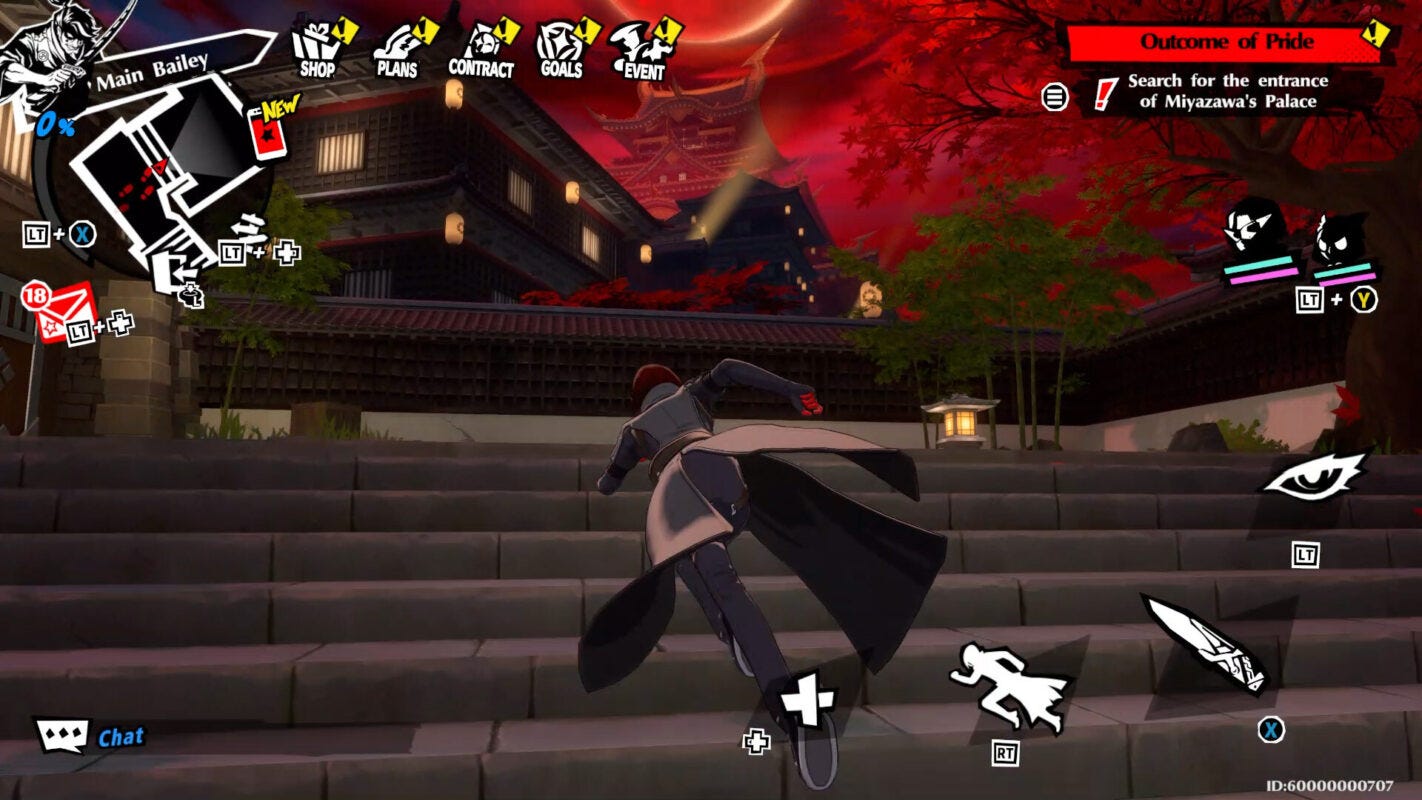
But (and you probably saw this com-innnnng) it’s the Gacha mechanics that are breaking the game for me. During the streams, I was grinding out Golden Tickets so I could unlock a high-level Phantom Idol (the game’s term for the summoned heroes). I went with Ann/Panther, since she meshed better with the other characters I had gotten through the Gacha system. And immediately after I unlocked her, the game dropped its first real-money prompt: “Hey, don’t you want all this Ann-specific upgrade material at a hefty discount?” I declined it, but there is now a glowing yellow “1” at the top of my screen.
From there, the Gacha only introduces itself further. I unlocked a ton of Phantom Idols, most of whom are brand new characters, and that was fun. And they all have upgrade paths, which is a nice feature. And then I finally got to the Airsoft Shop, where I can’t buy upgrades, but I can pay Iwai to throw a briefcase with 10 random weapons in it at me. And all those weapons have upgrade paths just like my Phantom Idols do. And that’s when I realized there’s also an equivalent upgrade path for every. single. Persona. Every one of them has dozens of levels that are upgraded with various materials that I can only grind out by completing challenges or fighting in Mementos, all level-locked to a specific item to push them over the edge or to Wonder’s own level.
If you enjoy Gacha games, this will likely appeal to you. And if you’ve watched my streams, you know I love the idea of “number go up”. But there’s just so many damn numbers here. Juggling all the Phantom Idols, maybe even the weapons, would be fine. But I’m leveling up all these Personas, too? Finding unique items to “overclock” them? Then fusing them to make more Personas? I get that it’s the point of a Gacha game, but it’s a lot, and it distracts from what I really want from a Persona game: a complex and twisting story with characters I love and an adventure that pushes my party to the brink.
How Long is the Contract For, Igor?
And this, of course, brings us to the next great concern about Persona 5: The Phantom X: what happens next? This will be, at best, a side story relegated to the same hell as Persona 5 Royal (remember, vanilla Persona 5 appears to be the canon entry, based on events that occur in spin-offs Strikers and Tactica). And like other mobile games, The Phantom X will inevitably reach a point when the service will end, just like so many before it. What happens then? Will this story be lost to time? How long will this game allow players to throw real-world currency at it and get invested in its world before its development ends, and all that’s left are a few disparate YouTube Let’s Plays?
I know I’ve rambled on for a while, but please don’t consider this a review. I’ve only played a few hours of The Phantom X, and I just wanted to get these thoughts out there while they were bouncing around in my head. The issue isn’t that The Phantom X is bad, but just that I didn’t immediately fall in love with it the way I expected to. And maybe that’s more my fault than yours. I think you should check it out if you liked Persona 5 in any of its iterations, especially if you enjoy Gacha games. But go in with an open mind and prepare yourself for an experience that isn’t perfect, no matter how much it charms you into believing otherwise.
The post I’m Trying to Love Persona 5: The Phantom X, But It Just Hasn’t Stolen My Heart appeared first on Homeworld.